
The Verdict Database Built at Scale
Most verdict data is compiled by hand, one award at a time, and covers only the biggest cases. Premonition indexes the whole docket.
Cases Indexed
Court Documents
Verdicts
US Civil Courts
From Complaint to Estimate in Three Steps
No manual research, no guesswork. Upload a complaint and get a defensible number, explained.
Select Venue & Case Type
Tell Verdicts which court and case type you're working with, so every comparison that follows is apples-to-apples.
Upload the Complaint
Drop in your case complaint. No manual data entry or spreadsheet building required.
Get an Explained $ Estimate
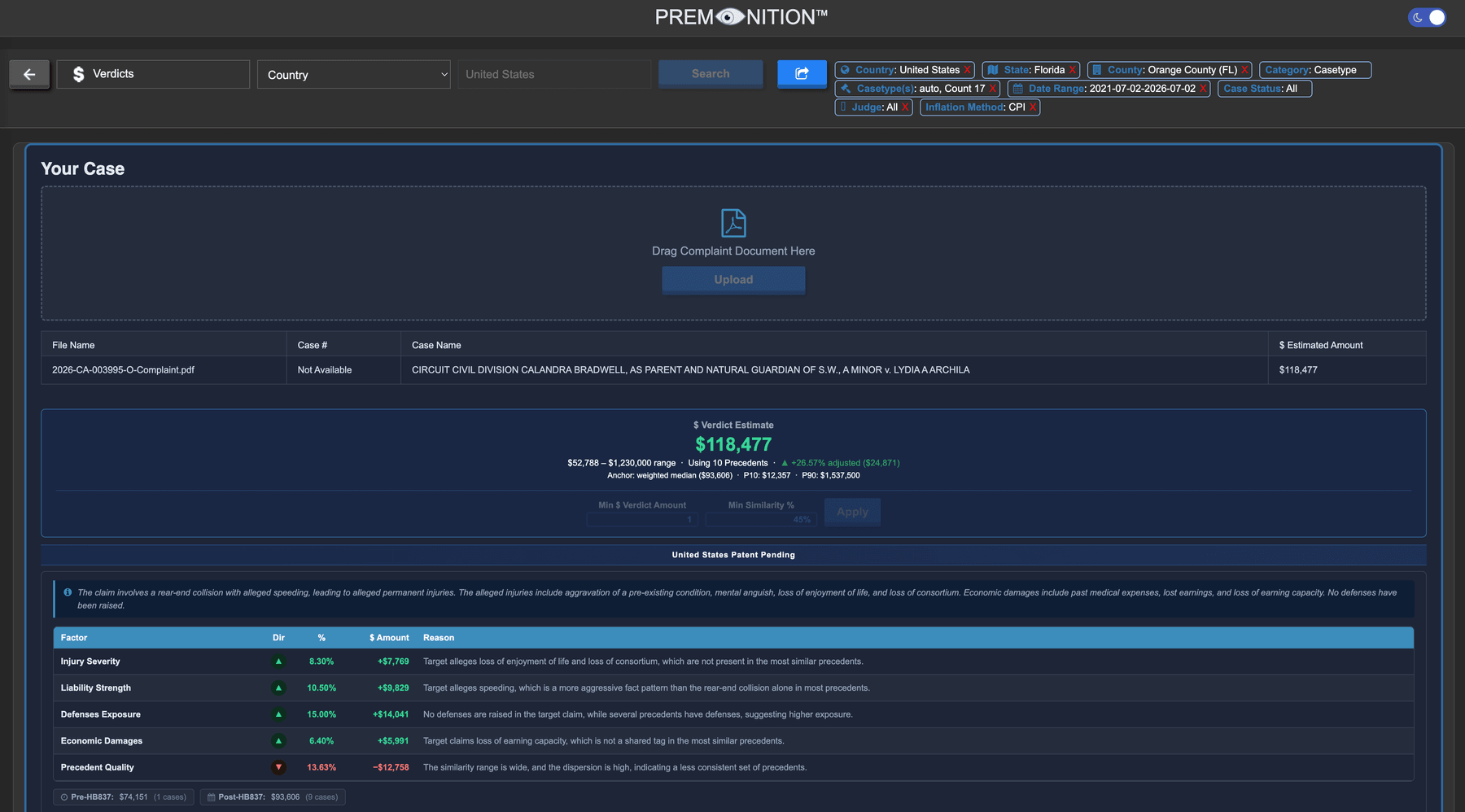
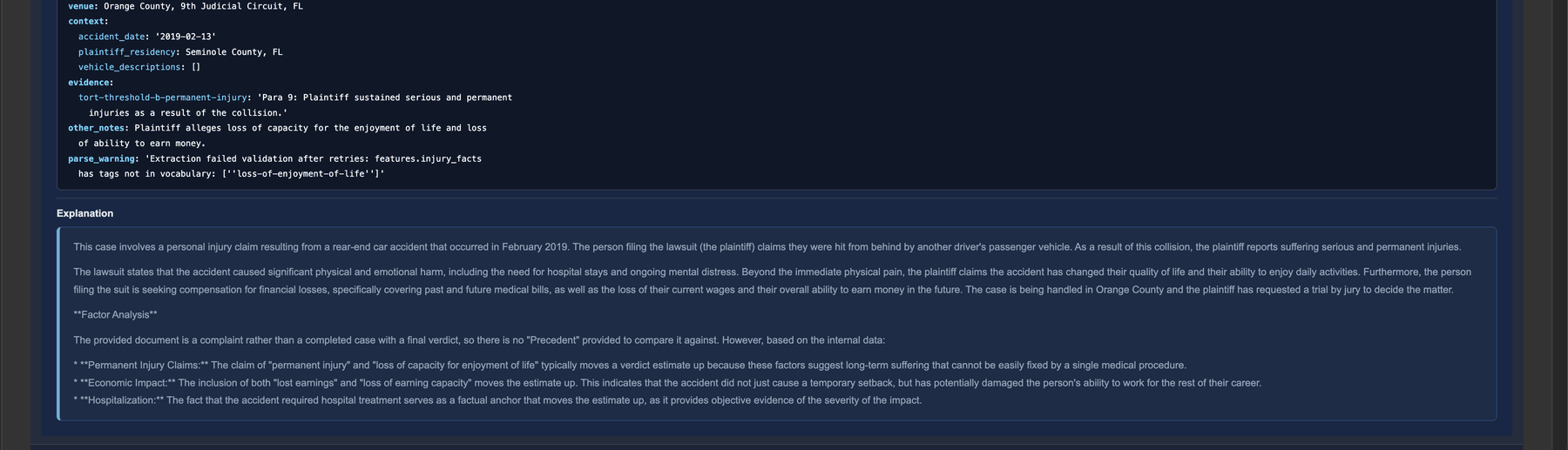
An AI agent trained on a Law Knowledge Graph for your case type and jurisdiction reads the complaint, compares it to recent cases from your court, and returns a verdict estimate — with an explanation of which factors moved the number, by percentile and by dollar amount.
A Number You Can Defend
Every estimate comes with the range and reasoning behind it, not just a figure.
- A low–high range with P10/P90 percentiles, built from your closest matching precedents (e.g. “Using 10 Precedents”)
- Every historical verdict amount re-calculated for inflation, using CPI or M2
- Applicable tort-reform regimes — like Florida’s HB837 — accounted for automatically
- An anchor you can point to in a demand letter, mediation, or motion, backed by the cases behind it
Every Dollar, Explained
The estimate isn’t a black box. A factor breakdown shows exactly what moved the number, and by how much — each with its direction, its percentage effect, and its dollar effect, in plain English.
Injury Severity
More severe or permanent injuries push the estimate up; soft-tissue or fully-recovered injuries pull it down.
Liability Strength
Clear-cut liability increases the estimate; comparative fault or disputed liability reduces it.
Defenses Exposure
Strong applicable defenses drag the number down; weak or unavailable defenses leave it intact.
Economic Damages
Documented medical bills, lost wages, and future costs scale the estimate up in proportion to what's proven.
Precedent Quality
The more closely a precedent matches on venue, case type, and facts, the more weight it carries in the final number.
See the Cases Behind the Number
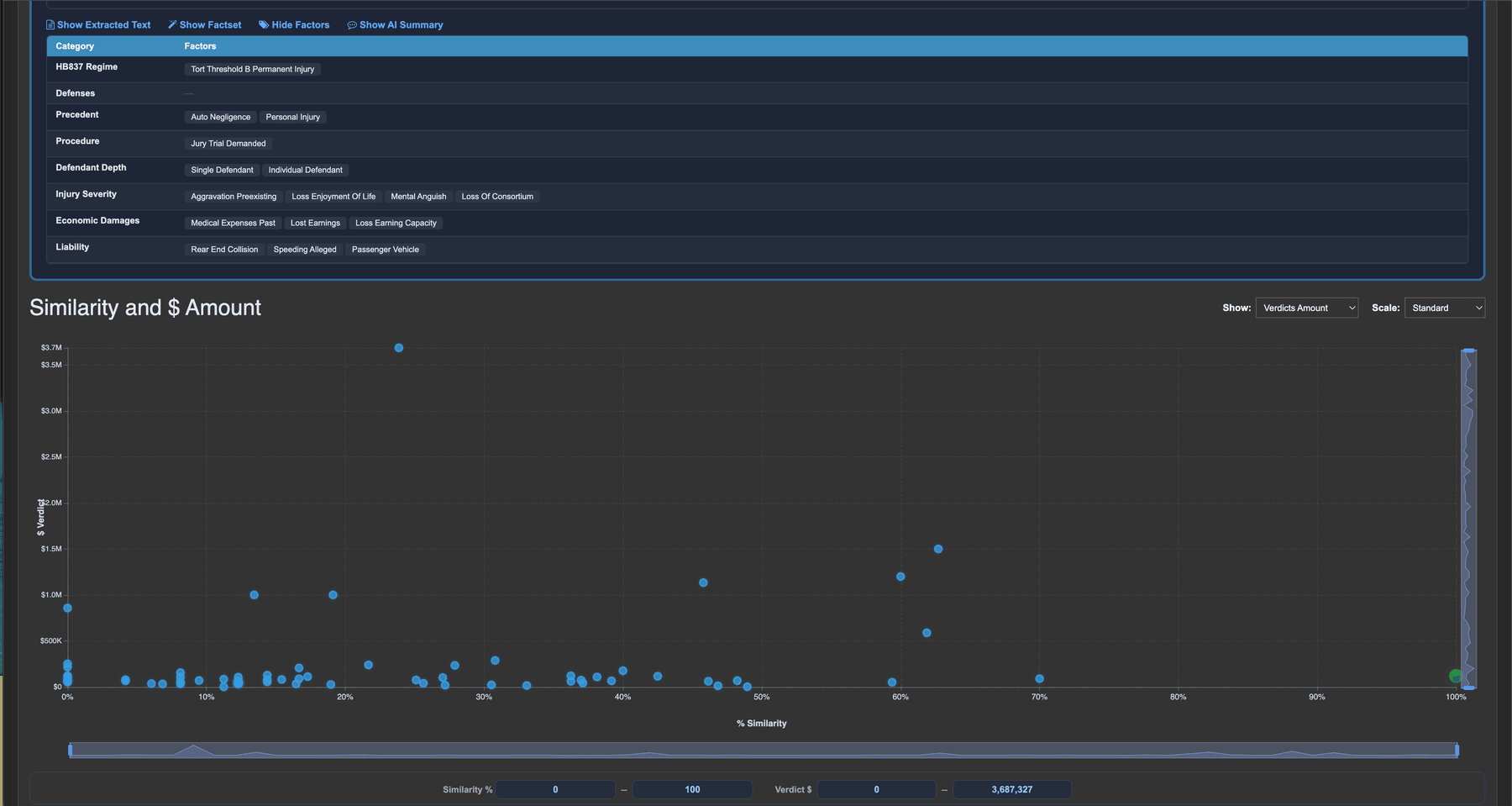
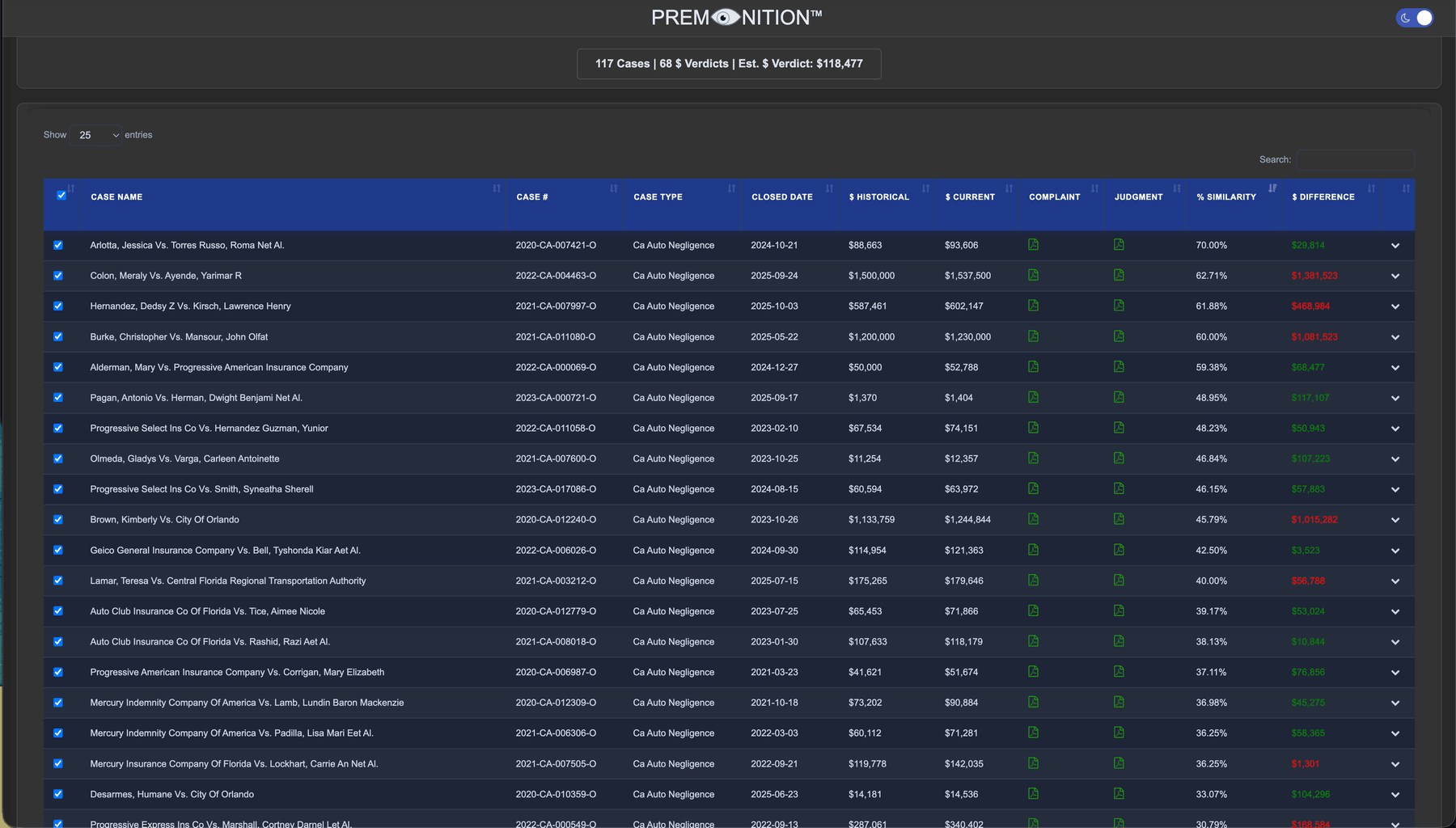
Every estimate is traceable to the verdicts that produced it — over 100 comparable cases, ranked and mapped.
Every comparable case, ranked
A ranked list of 100+ comparable cases — case name, case #, case type, closed date, historical and inflation-adjusted amount, percent similarity, and the dollar difference from your case. Sort, search, and exclude any case you don't want counted.
The factors behind every match
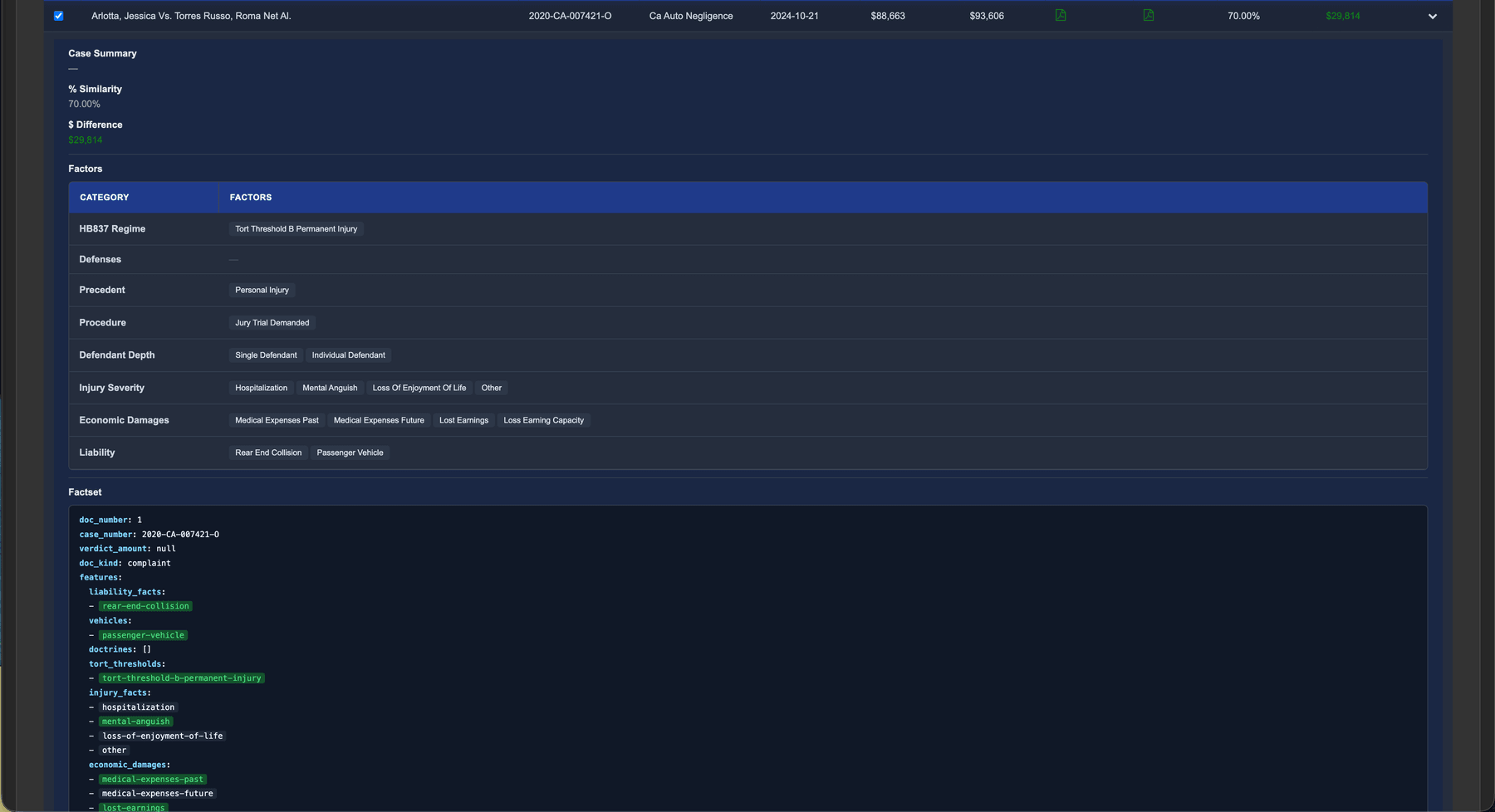
A structured factset for each precedent shows how it compares to yours by percent similarity and amount, with per-factor detail across injury severity, liability, economic damages, and precedent quality — plotted on a similarity-versus-value scatter so outliers and clusters are visible at a glance.
Written for a lay audience
Every matching precedent is explained in plain English for a lay audience such as a jury, so the reasoning is clear to non-lawyers. Adjust the dollar range and similarity threshold, and the estimate and explanation update with it.
Built to Leave Your Desk
A report only helps if the right people can see it — live, or on paper.
- Share a Saved Search link with a colleague who can edit the report live
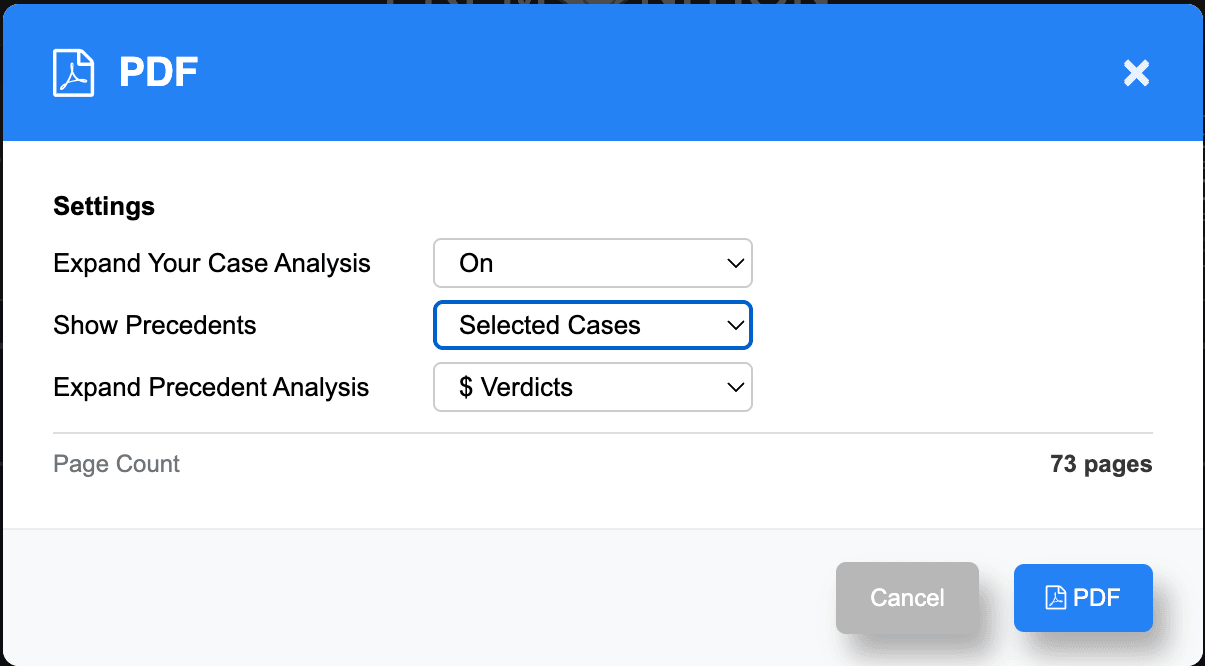
- Export a court-ready PDF, with control over which precedents and how much analysis is included
- Built for three audiences: the Court, the Client, and Opposing Counsel
A Very, Very Unfair Advantage
Advocating for a verdict amount outside a proven range is hard to justify. A lawyer who walks into a hearing or settlement conference with a report like this — against an opponent who doesn’t have one — starts from a stronger position.
Largest Verdict Dataset
14.99 million verdicts drawn from a database with more coverage than LexisNexis, Thomson Reuters, and Bloomberg combined.
Defensible & Explainable
Every estimate cites its precedents and shows exactly which factors moved the number, and why.
Negotiate From Proof
Set a settlement range or jury ask surrounded by measurably similar verdicts, not instinct.
Know What Your Case Is Worth. Before They Do.
See Verdict Analysis on one of your own case complaints. Schedule a demo with our team.